

How Does a Vacuum Conveyor Work?
Release time: 2025-11-04
Table of Contents
In modern production lines, the efficiency of transporting powders, granules, and small materials directly affects overall output. Because vacuum conveyors are sealed, hygienic, and highly automated, they have become widely used in the food, chemical, pharmaceutical, and plastics industries.
So how exactly does a vacuum conveyor work? Here’s a simple, easy-to-understand explanation.
1. Core Principle: Using Negative Pressure to Move Materials
A vacuum conveyor works by creating a pressure difference.
Vacuum created → Pressure difference forms → Material gets pulled into the system
When the vacuum pump (or vacuum generator) starts, it removes the air inside the conveying pipeline, creating a lower pressure than the surrounding environment. At this moment:
- The pressure outside is higher
- The pressure inside the pipeline is lower
- Material is naturally drawn into the pipeline by the airflow created by this pressure difference
This is how materials get “sucked up” and transported.
2. Main Components of a Vacuum Conveyor
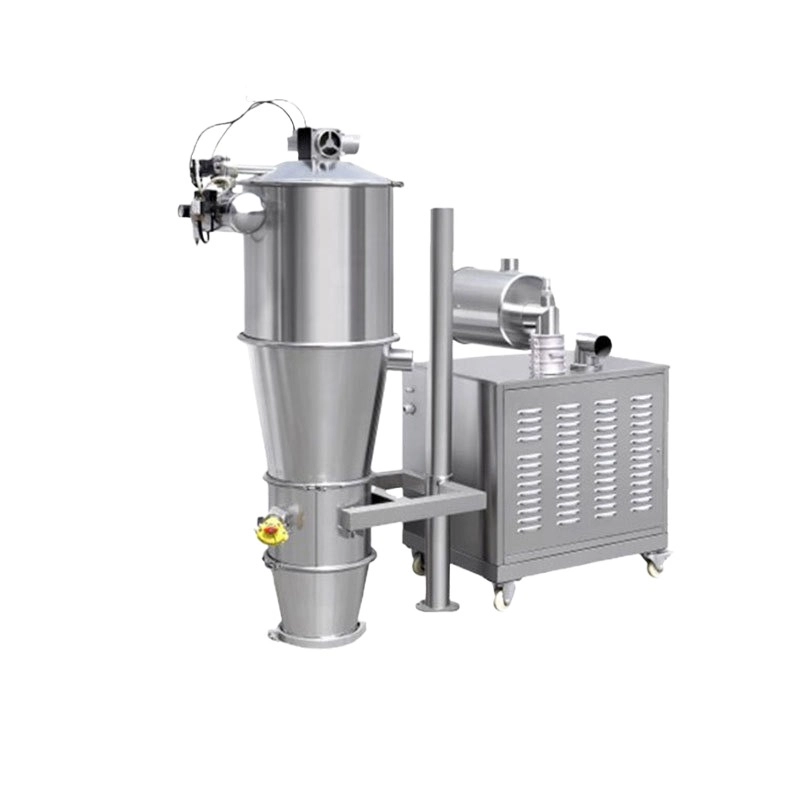
A standard vacuum conveying system includes:
- Vacuum pump / vacuum generator (creates negative pressure)
- Conveying pipeline
- Filter system (prevents dust from entering the vacuum source)
- Vacuum receiver/collection hopper
- Automatic control system
- Discharge valve
These components work together to achieve clean, continuous, enclosed conveying.
3. How Does a Vacuum Conveyor Operate Continuously?
A full conveying cycle usually consists of three stages:
1)Suction Phase
The vacuum pump starts and creates negative pressure.
Material is sucked from the source (bag dump station, bin, or container) into the pipeline and transferred to the vacuum receiver.
2)Separation & Filtration
Once inside the receiver:Material is trapped by filters, Air passes through and continues to the vacuum pump. This prevents dust or fine powder from damaging the equipment.
3)Discharge Phase
When suction is complete:
- The vacuum pump stops
- The discharge valve opens
- Material flows into downstream equipment such as: Mixers, Dosing devices, Extruders, Packaging machines
Then the system repeats the cycle for continuous conveying.
4. What Materials Can a Vacuum Conveyor Handle?
Suitable materials include:
- Food powders (flour, sugar, milk powder)
- Chemical powders
- Pharmaceutical powders and granules
- Plastic granules and resins
- Metal powders
- Additives, pigments, carbon powder
Most dry, free-flowing powders or granules can be transported through vacuum conveying.